


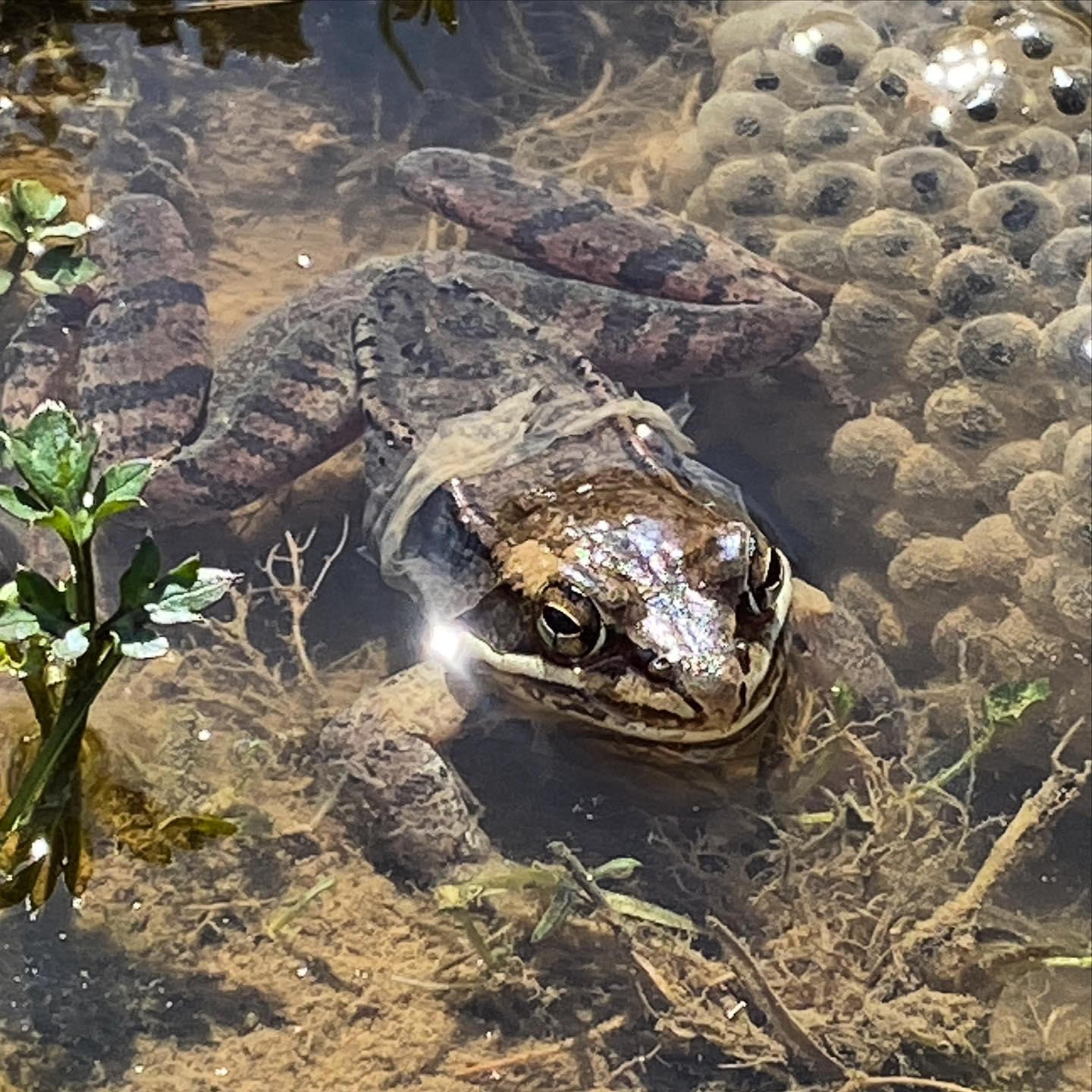
Spring doesn’t come easy to Garrett County. Up here in Maryland’s highest corner, it arrives slowly — grudgingly, almost — through cold nights and raw, grey days, patches of snow that refuse to quit. The trees are still bare, the wind still has teeth, and the skies open up with cold rain that can’t quite decide if it wants to be sleet. But while the landscape looks like it belongs to winter, something ancient is stirring beneath the leaf litter and ice-edged water.
Before the wildflowers. Before the warblers. Before most people would dare call it spring at all — the frogs wake up.
Out in the flooded hollows and the dark forest pools of Garrett County, the wetlands erupt into a chorus that has echoed through these hills for countless generations. This is the season of the frogs, and if you haven’t experienced it on a raw March afternoon with mud on your boots and rain on your jacket, you haven’t truly felt a Garrett County spring. It is one of nature’s most spectacular — and most overlooked — performances.
At AllEarth Eco Tours, we love nothing more than leading guests to the edge of a vernal pool to listen to that ancient song. Book your hike with us soon at allearthtours.com — these amphibian windows are brief, and you don’t want to miss them!
What Are Vernal Pools — and Why Do They Matter?
Before we meet our amphibian stars, let’s talk about the stage they perform on: vernal pools.
Vernal pools are temporary, seasonal wetlands that fill with snowmelt and spring rains, typically in late winter and early spring. They dry up by midsummer — and that’s exactly what makes them magical. Because they’re temporary, they contain no fish, which means they’re safe nurseries for species that would otherwise be devoured before reaching adulthood.
For wood frogs, spring peepers, spotted salamanders, and marbled salamanders, vernal pools aren’t just convenient — they are essential. Many of these species breed only in vernal pools and return to the same pool year after year, often navigating back to the very pool where they were born.
Beyond amphibians, vernal pools support a rich web of life:
- Fairy shrimp, water fleas, and aquatic insects thrive in the temporary waters
- Migratory birds use pools as feeding stops
- Raccoons, herons, and foxes feast on egg masses and emerging juveniles
- Forest nutrient cycles benefit from the organic matter that frogs and salamanders carry from pool to forest and back
Lose the vernal pools, and you lose the amphibians. Lose the amphibians, and the entire forest ecosystem begins to unravel. Amphibians are critical bio-indicators — their presence or absence tells us volumes about the health of an ecosystem. They also consume enormous quantities of insects, connecting aquatic and terrestrial food webs in ways scientists are still working to fully understand.
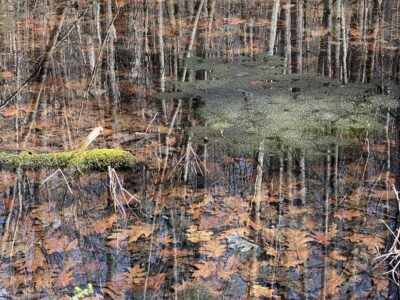
Learn more about vernal pool conservation:
Vernal Pool Association
USDA Forest Service – Vernal Pools
Wood Frogs: Garrett County’s “Turkey Frog”
If there is one frog that deserves a superhero cape, it’s the wood frog (Lithobates sylvaticus).
Wood frogs are among the first animals to signal that Garrett County’s long winter is truly over. They begin calling as soon as temperatures creep above freezing — sometimes while snow is still on the ground and the forest pools are barely thawed at the edges. Their call is a raspy, gobbling cluck that sounds remarkably like a wild turkey — and when hundreds of frogs join in at once, it truly sounds like a flock of turkeys has materialized in the middle of the forest. In fact, in many parts of Appalachia — including Garrett County, Maryland — wood frogs are fondly known as “turkey frogs” because the resemblance to a turkey’s call is so striking. It’s one of the most delightfully surprising sounds in the natural world.
Frozen and Resurrected
Here’s where things get truly astonishing: wood frogs freeze solid during winter. Ice crystals form inside their bodies. Their hearts stop. They stop breathing. By any normal standard, they appear dead. Yet when temperatures rise in spring, they thaw and hop away, ready to breed.
They accomplish this through a remarkable process of producing glucose as a natural antifreeze, protecting their cells from ice crystal damage.
This adaptation makes wood frogs one of the few vertebrates on Earth that can survive being frozen.
Interesting Facts About Garrett County Wood Frogs
- Wood frogs are forest-dependent and rarely venture far from wooded areas
- They have a distinctive dark “robber’s mask” across their eyes
- The entire breeding season lasts only a few days to two weeks — blink and you’ll miss it
- Females lay communal egg masses that can contain thousands of eggs, often clumped together in the same area of the pool for warmth
- After breeding, wood frogs disappear back into the forest and are rarely seen again until the following spring
- They range further north than almost any other frog in North America — all the way to the Arctic Circle
Watch this wonderful video of Appalachian wood frogs by Crede Calhoun on
YouTube: Wood Frogs by Crede Calhoun – YouTube
Further reading:
Wood Frog – National Wildlife Federation
Wood Frog Facts – Amphibiaweb
Spring Peepers: Small Frog, Enormous Voice
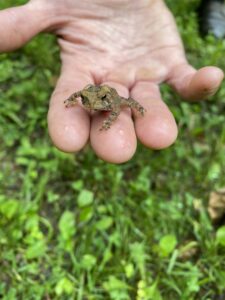
Don’t let their tiny size fool you. Spring peepers (Pseudacris crucifer) are barely the size of a thumbnail — roughly three-quarters of an inch long — yet their high-pitched peeping calls can be heard from half a mile away. When a full chorus gets going, the sound is almost deafening up close.
Spring peepers are named for their signature call: a clear, high whistle repeated roughly once per second by each male. Thousands calling together creates a shimmering, bell-like wall of sound that is one of the most iconic soundscapes of a Garrett County spring evening — rising up from roadside ditches, beaver wetlands, and flooded forest hollows all across the county.
Interesting Facts About Spring Peepers
- They have a characteristic X-shaped marking on their backs, which gives them their species name crucifer (cross-bearer)
- Like wood frogs, they can partially freeze and survive winter under leaf litter and bark
- Males call by inflating a vocal sac beneath their chin into a bubble nearly as large as their own body
- A female selects a mate based on the speed and quality of his call — faster calling generally indicates a stronger, healthier male
- They are tree frogs and have adhesive toe pads, allowing them to climb vegetation
- Spring peepers breed slightly later than wood frogs, extending the amphibian chorus season through April and May in Garrett County
- Despite being incredibly vocal, they are very difficult to spot — their brown and tan coloring makes them nearly invisible against leaf litter
Further reading:
Spring Peeper – Savannah River Ecology Lab
Spring Peeper – Cornell Lab of Ornithology (search “spring peeper” in nature sound archives)
Bullfrogs: The Giant of the Pond
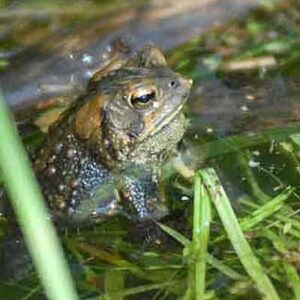
No spring and summer amphibian blog would be complete without the American bullfrog (Lithobates catesbeianus) — the heavyweight champion of North American frogs.
Bullfrogs are the largest native frog in North America, with adults reaching up to 8 inches in body length and capable of jumping distances of several feet. Their deep, resonant call — often described as “jug-o-rum” — is the unmistakable bass note of a warm-weather wetland.
Unlike wood frogs and spring peepers, bullfrogs are warm-weather breeders and don’t typically call until late spring and summer, when water temperatures rise. They are year-round residents of ponds, lakes, and slow-moving streams rather than vernal pools.
Interesting Facts About Bullfrogs
- Bullfrogs can live up to 7–9 years in the wild — a long lifespan for a frog
- They are voracious, ambush predators and will eat almost anything they can fit in their mouths: insects, crayfish, small snakes, mice, birds, and even other frogs
- Males are highly territorial and defend prime calling spots aggressively
- The tympanum (eardrum) behind the eye is a reliable way to tell males from females — in males it is larger than the eye; in females it is the same size or smaller
- Tadpoles can take 1–3 years to metamorphose into adults, overwintering as tadpoles in pond mud
- Bullfrogs produce a skin toxin that makes them unpalatable to many predators
- In areas outside their native range, bullfrogs are considered invasive and can decimate populations of native frogs and salamanders — a stark reminder of how important native species balance is to healthy ecosystems
- While bullfrogs don’t depend on vernal pools the way wood frogs and salamanders do, they are an important part of the broader wetland ecosystem — both as predators and as prey for herons, otters, raccoons, and large snakes.
Further reading:
American Bullfrog – National Wildlife Federation
Bullfrog – Amphibiaweb
When to Go — The Window Is Short!
The amphibian season moves fast in Garrett County:
Species Peak Activity (Garrett County)
Wood Frog Late February – March
Spring Peeper March – May
Spotted Salamander February – March (night migration)
Bullfrog May – August
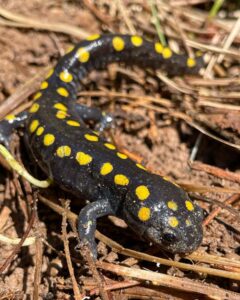
The very best time to witness wood frogs and spring peepers is on warm, rainy days in late February through April, when the air finally softens and the forest pools fill with snowmelt. Spotted salamanders make their migrations on the first warm, wet nights of the year, and those “big nights” can see thousands of salamanders crossing Garrett County’s roads — but the frogs are a daytime experience, calling from the pool edges on mild afternoons when the sun briefly wins its battle with the cold. Given how late winter lingers up here, these days feel all the more magical when they finally arrive.
Book Your Spring Hike with AllEarth Eco Tours!
There is simply nothing like standing at the edge of a vernal pool on a spring evening, surrounded by the ancient chorus of frogs that have been singing in these mountains long before humans arrived. Our expert naturalist guides will help you find, identify, and appreciate these remarkable amphibians in a way that’s safe for both you and the wildlife.
Don’t wait — spots fill fast during peak amphibian season!
Book your hike today at allearthtours.com
Follow us for more nature content and trip updates — and check out more amazing Appalachian wildlife videos on our YouTube channel!
AllEarth Eco Tours is committed to low-impact, educational nature experiences that foster a deep appreciation for the natural world. We follow Leave No Trace principles on all our hikes and ask that guests never handle wild amphibians, as the oils and chemicals on human skin can be harmful to them.