


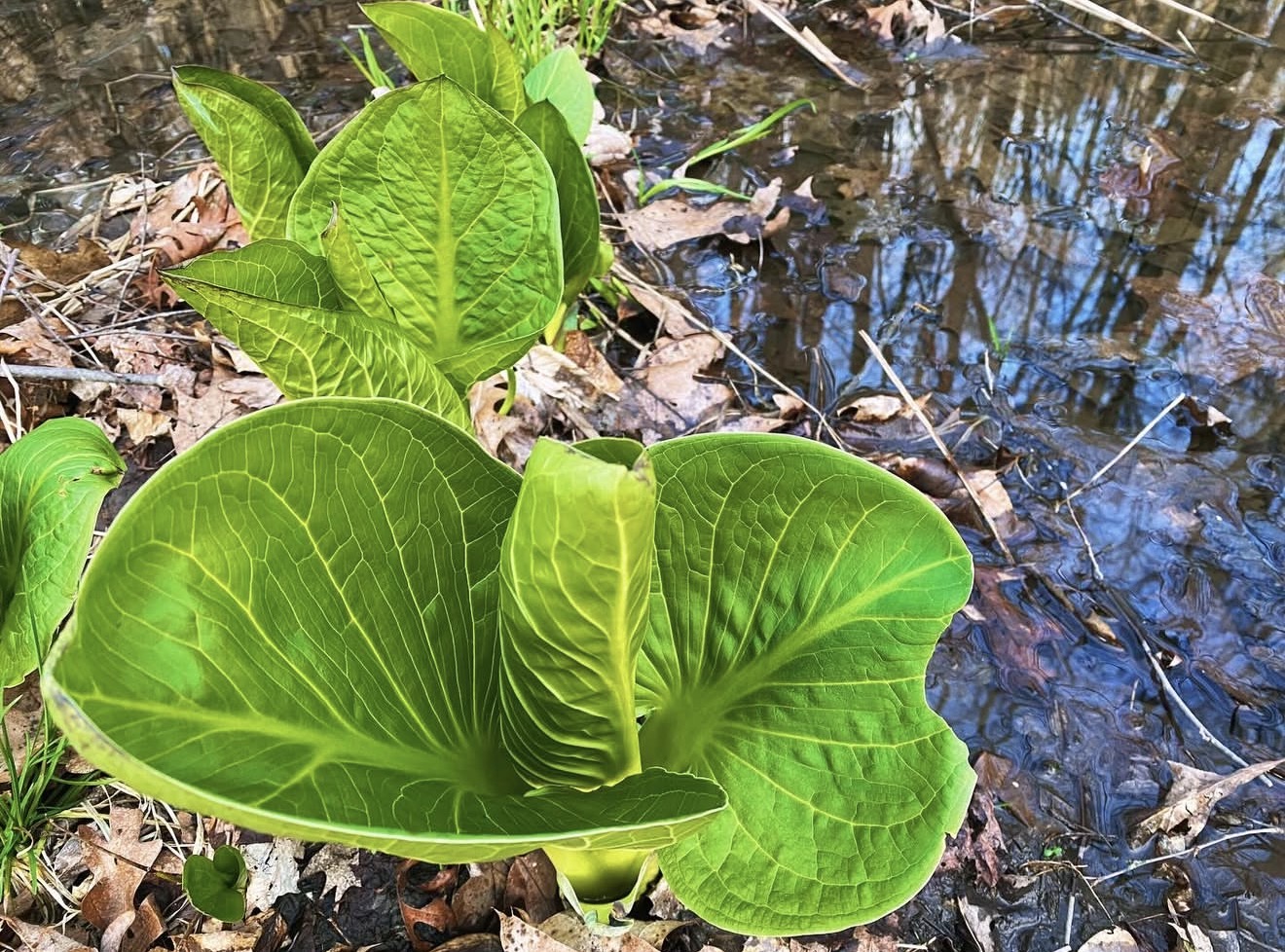
Right now, in wet woods across the Eastern US, a plant called Skunk Cabbage is generating its own body heat — up to 70°F above the surrounding air temperature — and melting through frozen ground from below.
This isn’t photosynthesis. This is thermogenesis. The same process your body uses to stay warm.
The name doesn’t help it. Skunk cabbage. People hear it and wrinkle their noses. But out on our guided hikes through the wetlands and woodland streams of the region, skunk cabbage is one of the first things we seek out in early spring — and it never fails to stop people in their tracks.
Once you know what this plant is actually doing, you will never walk past a frozen swamp in March the same way again.
What Is Skunk Cabbage?
Eastern skunk cabbage (Symplocarpus foetidus) is a native wetland wildflower found throughout the northeastern United States — from Nova Scotia down to Tennessee and across into the Midwest. Despite the name, it’s not a cabbage at all. It’s a member of the Araceae (arum) family, making it a botanical cousin of jack-in-the-pulpit, calla lilies, caladiums, and yes — the monsteras and philodendrons sitting in your living room.
It grows in mucky, wet soil along stream banks, in bogs, and in shaded woodland wetlands. The unglamorous, overlooked corners of the landscape. Which, as it turns out, is exactly where the most extraordinary things tend to happen.
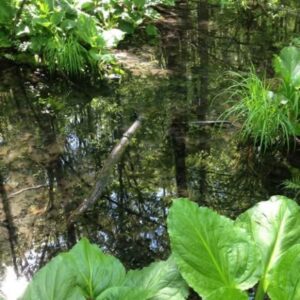
The Superpower: It Generates Its Own Heat and Melts the Snow
Here is what skunk cabbage is doing right now, in March, while everything else is still dormant:
- It is one of the only plants on Earth that produces metabolic heat
- It burns stored starch at a rate comparable to a small mammal
- Its internal temperature holds steady at 68–77°F even when outside air is 15°F
- It pushes through snow and frozen soil by literally melting a tunnel from underneath
- The heat volatilizes its chemicals — producing a rotting-meat smell that attracts the first flies of the season
This phenomenon is called thermogenesis, and skunk cabbage is a world champion at it. The colder the air temperature, the harder the plant works to maintain its internal warmth. Scientists have found it uses as much metabolic energy per unit of weight as a small mammal in winter. It is, in the most literal sense, warm-blooded.
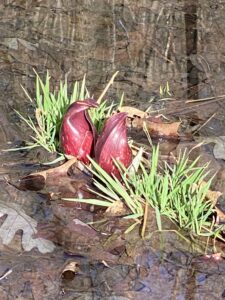
The result is one of nature’s most startling sights: circles of bare, thawed earth scattered across an otherwise snow-covered wetland — each one centered on a single mottled maroon hood poking up from the mud, radiating heat, while the rest of the world is frozen solid.
Dig into the science: Chemical Education Xchange | Couchiching Conservancy
There’s a Heated Pollination Station Inside That Hood
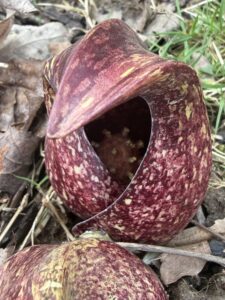
What you see poking out of the mud — that mottled maroon-and-yellow hooded structure — is not the flower. It’s called the spathe, and it functions as a greenhouse, a furnace, and a landing pad all at once.
Inside the spathe, on a rounded club-like spike called the spadix, dozens of tiny petal-less flowers are packed together in bloom. The spathe’s narrow opening is just wide enough for a cold, early-season fly to squeeze through.
Those early flies crawl inside the hooded spathe, get warm, pick up pollen, and carry it to the next furnace down the creek.
The heat also volatilizes the plant’s sulfur compounds, sending the smell of rotting meat drifting through cold air for a surprising distance — a precise chemical signal to the first insects of the season that warmth is waiting. As a pollination strategy, it is ruthlessly effective.
Unlike most plants, skunk cabbage produces its female flower parts first, only releasing pollen later — a clever insurance policy against self-pollination.
The spathe’s mottled coloring mimics the flickering shadow and light of the forest floor, making it remarkably hard to spot even when you’re standing right next to one. Finding your first skunk cabbage of the season genuinely feels like finding a secret.
More on the flower structure: Brooklyn Botanic Garden | Chesapeake Bay Program
It Starts in February. March Is When You Can Actually Find It.
Skunk cabbage begins pushing up as early as February — sometimes January — making it the first wildflower of the year across most of eastern North America. It doesn’t wait for warmth. It makes its own.
But February means braving the coldest, iciest conditions of the year to find it. March is the sweet spot. The spathes are up in full force, the hidden flowers inside are actively blooming, and the wetlands and stream corridors where skunk cabbage thrives are accessible and extraordinary.
Skunk cabbage flowers before producing a single leaf. Those enormous, tropical-looking leaves — up to 3 feet long — don’t unfurl until spring is fully underway. By the time the forest greens up, skunk cabbage has already done its work. The leaves die back by late summer. The plant itself lives on underground, returning to the same patch of wetland year after year from a deep, anchored rhizome — for 20 years or more.
March’s first bloom doesn’t wait for warmth. It makes its own.
Bears Know What’s Good
When black bears emerge from hibernation in early spring, skunk cabbage is one of the first things they go looking for. Most herbivores pass it by — but bears, snapping turtles, wood ducks, ruffed grouse, and ring-necked pheasants all make use of various parts of the plant.
In 1942, Hanis Coos Elder Lottie Evanoff summed it up perfectly: “Bear eats skunk cabbage, is just crazy for it. So it must be good eating — everything bear eats is good eating.”
Hard to argue with that logic.
Indigenous Peoples Ate It — With Serious Know-How
A question that comes up on nearly every skunk cabbage hike: did Indigenous peoples really eat this thing? The answer is yes — documented across many nations, but with a critical catch.
All parts of skunk cabbage contain calcium oxalate crystals, which cause an intensely painful burning sensation when eaten raw. This is not a plant you forage casually. However, numerous Indigenous nations developed techniques to neutralize these compounds and use the plant as both food and medicine.
Documented uses span the Abnaki, Chippewa, Delaware, Haudenosaunee, Malecite, Menominee, Meskwaki, Micmac, Mohegan, and Nanticoke peoples. Young leaves and shoots were boiled through multiple changes of water, or roots were dried and processed into starch for bread. The Haudenosaunee cooked young shoots with salt, pepper, or butter. The large leaves were used to wrap foods and line earth ovens.
Medicinally, the plant was widely valued — and was listed in the U.S. Pharmacopoeia from 1820 to 1882 as the drug “dracontium,” prescribed for respiratory diseases, nervous disorders, and rheumatism.
Do not forage skunk cabbage without expert guidance. Raw plant parts are genuinely toxic. This is a plant to seek out and admire — not snack on.
Indigenous uses in depth: Cornell Botanic Gardens | Oregon Encyclopedia
This Is What March Looks Like in the Woods
While you’re still wearing a winter coat, skunk cabbage is running a heated pollination station in a frozen swamp.
It is bizarre. It is ancient — this genus has existed for tens of millions of years. It is proof that the natural world is operating at a level of complexity and ingenuity that most people drive past every single day without knowing.
Nature doesn’t wait for spring. In the right places, it never really stopped.
Come See It in Person
The best way to understand what skunk cabbage is actually doing — to see the thawed circles in the snow, to peer inside the spathe at the hidden flowers, to smell it once and understand immediately why the flies come running — is to be out there in the field when it’s happening.
At All Earth Eco Tours, our guided hikes take you through the wild wetlands, stream corridors, and woodland edges where skunk cabbage thrives — with guides who know where to look and what it all means. Whether you’re a lifelong naturalist or someone who just wants to be genuinely surprised by the world outside your door, there’s a hike for you.
March is prime skunk cabbage season. The window is open now. Book your guided hike at allearthtours.com.
All Earth Eco Tours has been exploring, studying, and sharing the natural world of the Eastern US for over 30 years. Our guides bring deep knowledge and genuine passion to every hike — because the natural world is endlessly worth paying attention to.
Further Reading & Sources
Skunk Cabbage — Cornell Botanic Gardens
Skunk Cabbage Thermogenesis — Chemical Education Xchange
Skunk Cabbage: A Warm-Blooded Plant? — Couchiching Conservancy
What Can We Learn from the Skunk Cabbage? — Brooklyn Botanic Garden
The First Blooms Bring the Heat — Chesapeake Bay Program
Skunk Cabbage — Wisconsin Horticulture Extension
Skunk Cabbage — Oregon Encyclopedia