


Before the trees wake up, the forest floor throws a party. For a few precious weeks each spring, the woodlands of Garrett County erupt in waves of color — delicate, fleeting, and utterly irreplaceable.
Most visitors to Deep Creek Lake and Garrett County, Maryland arrive in summer for the lake, or in fall for the foliage. But spring — raw, cool, still a little muddy — belongs to the wildflower lovers. These early bloomers are called spring ephemerals: plants that race through their entire above-ground life cycle in just six to eight weeks, vanishing back underground before summer even arrives.
They’re not just beautiful. They’re ecologically vital, supporting the first pollinators of the season, stabilizing forest soils, and cycling nutrients back to the trees that will soon shade them out. Miss the window, and you’ll wait another year.
At All Earth Eco Tours, we’ve spent decades watching these wildflowers emerge along the trails of western Maryland. Here’s your guide to ten standout species — skunk cabbage, trout lily, Dutchman’s breeches, violets, bear corn, mayapple, bloodroot, trillium, pink lady’s slipper orchid, and Jack-in-the-pulpit — and where our guided hikes, nature tours, and foraging adventures can take you right into the heart of them.
What Are Spring Ephemerals?
Spring ephemerals are herbaceous plants that have evolved a remarkable strategy: emerge early, bloom fast, set seed, then disappear — all before the deciduous forest canopy closes overhead and blocks out the sun. They exploit a narrow window of light and warmth that exists only between snowmelt and leaf-out.
The timing is everything. Too early and a late frost can kill the blooms. Too late and the canopy shades them out. These plants have refined their timing over thousands of years, and they remain stubbornly in sync with the natural calendar — not the thermometer. A warm February won’t fool a trout lily.
“Spring ephemerals fill the void between snow cover and canopy — entrepreneurially taking advantage of bright conditions to make and store food for the rest of the year.”
Garrett County is one of the finest places in Maryland to witness this annual spectacle. The county’s elevation — the highest in the state — combined with its intact forests, clean streams, and rich Appalachian soils creates ideal habitat for a remarkable diversity of wildflower species.
When Do They Bloom? A Garrett County Timeline
Bloom timing shifts slightly year to year depending on winter severity and spring temperatures, but here’s a general guide for Garrett County’s wildflower season:
February – March: Skunk Cabbage, Hepatica
Late March – April: Bloodroot, Trout Lily, Spring Beauty
April: Dutchman’s Breeches, Violets, Trillium, Wild Ginger
April – May: Mayapple, Bear Corn, Virginia Bluebells
May – June: Pink Lady’s Slipper, Jack-in-the-Pulpit, Wild Columbine
Garrett County’s Star Spring Wildflowers
These are the ten plants you’ll most likely encounter on a spring hike through Garrett County’s forests and hollows — including the ones we photograph on our own guided adventures.
Skunk Cabbage
Symplocarpus foetidus
Blooms: February – March
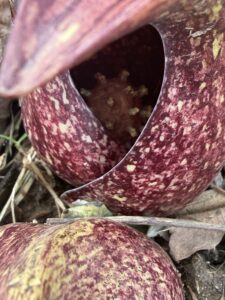
The first wildflower of the season, skunk cabbage earns its name honestly — crush a leaf and you’ll know immediately. But don’t let the smell put you off. This remarkable plant is the opening act of Garrett County’s entire spring wildflower season, and it has a superpower no other local plant can claim.
Skunk cabbage is thermogenic — it generates its own body heat through cellular respiration, raising the temperature inside its mottled purple-brown hood (called a spathe) up to 35°F warmer than the surrounding air. This allows it to melt through ice and snow to bloom when the rest of the forest is still frozen. The heat also helps disperse its odor, which attracts the early-emerging flies and gnats that pollinate it.
Look for skunk cabbage in the wet, boggy areas alongside Garrett County’s streams and in seep hollows. By April, the enormous cabbage-like leaves unfurl — and by summer, it’s gone. The brief window to see the spathe and flower is late February through early March.
Interesting Facts
→ Generates its own body heat — one of very few plants in the world to do so
→ Can melt through ice and snow to bloom in winter
→ Pollinated by early flies and gnats drawn to its warmth and scent
→ Found in wetlands, bogs, and stream edges throughout Garrett County
Learn more: Friends of the Mississippi River — Spring Ephemerals Guide
Trout Lily
Erythronium americanum
Blooms: Late March – April
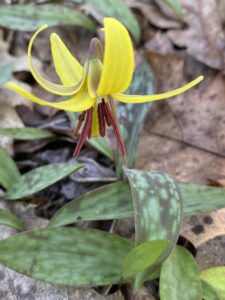
One of the most charming of all Garrett County’s spring wildflowers, trout lily gets its name from its mottled green-and-brown leaves — the same dappled pattern as a brook trout moving through clear water. The nodding yellow bell-shaped flower droops toward the ground, so you’ll want to crouch down to see it properly.
Trout lilies are ancient. A single colony can be over 300 years old — possibly older than many of the trees surrounding it. The plants take 7 years to produce their first flower. And they help the forest: research has shown that trout lilies actively transfer nutrients to maple trees via mycorrhizal fungi networks — a hidden generosity that supports the entire woodland ecosystem.
Interesting Facts
→ Mottled leaves resemble the markings of a native brook trout
→ Colonies can be 300+ years old — older than surrounding trees
→ Takes 7 years from seed to first bloom
→ Seeds are dispersed by ants attracted to fatty elaiosomes
→ Transfers nutrients to maple trees through underground fungal networks
Learn more: Maryland Grows — UMD Extension: Spring Ephemerals
Dutchman’s Breeches
Dicentra cucullaria
Blooms: April
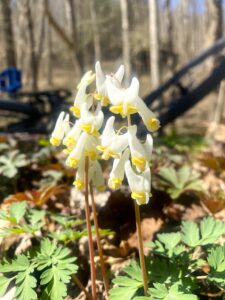
Of all the wildflowers that bloom in Garrett County each spring, Dutchman’s breeches is perhaps the most whimsical. The white-and-yellow blooms hang from a bare stem in a perfect row, looking for all the world like miniature pairs of pantaloons drying on a washing line — hence the name. The fern-like, feathery foliage is equally elegant.
This plant has a fascinating relationship with bumblebees: the nectar is stored deep in the “legs” of the upside-down flower, accessible only to long-tongued bees. The leaves are mildly toxic to most mammals, giving Dutchman’s breeches a natural defense — deer leave them entirely alone. Look for dense colonies on the rich, moist slopes of Garrett County’s forested hollows.
Interesting Facts
→ Flowers shaped like tiny upside-down pantaloons on a laundry line
→ Only long-tongued bumblebees can reach the nectar stored in the “legs”
→ Leaves are mildly toxic — completely deer-resistant
→ Seeds dispersed by ants (myrmecochory)
→ Part of the bleeding heart family (Papaveraceae)
Learn more: Virginia Outdoors Foundation — Spring Ephemerals Spotlight
Wild Violets
Viola spp.
Blooms: April
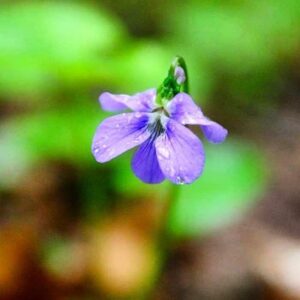
Few spring wildflowers are as beloved — or as overlooked — as Garrett County’s wild violets. Several species bloom across the county each April, from the common blue violet to the bird’s foot violet and yellow forest violet, painting forest floors, stream banks, and meadow edges in shades of purple, blue, and gold.
Here’s what most people don’t know: violets are edible. Both the flowers and young leaves are rich in vitamins A and C — historically used in salads, candied as confections, and brewed into teas and syrups. On our foraging adventures, violets are one of the first plants we introduce to guests new to wild edibles. They’re safe, easy to identify, and genuinely delicious.
Violets also serve as the sole larval host plant for several species of fritillary butterflies — making them a critical piece of the forest food web, not just a pretty face.
Interesting Facts
→ Multiple species bloom in Garrett County — blue, purple, yellow, and white
→ Both flowers and young leaves are edible — rich in vitamins A and C
→ Sole larval host plant for several fritillary butterfly species
→ Historically used in salads, teas, and candied confections
→ One of our first introductions on foraging adventures
Learn more: Heartwood Native Plant Nursery — Spring Ephemerals
Bear Corn
Conopholis americana
Blooms: April – May
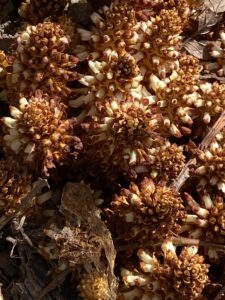
Bear corn is one of Garrett County’s most unusual wildflowers — and one of the most surprising. At first glance it doesn’t look like a plant at all. The thick, cream-to-brown spikes push up from the soil near the bases of oak trees looking more like pine cones or rotting corn cobs than flowers. That’s because bear corn has no chlorophyll whatsoever. It cannot photosynthesize. Instead, it is entirely parasitic — drawing all its nutrition from the roots of oaks and beeches through specialized root structures called haustoria.
The plant spends its first four years entirely underground before sending up its distinctive flowering stalks, which bloom for only about three weeks. And then there’s the name: black bears actively seek out bear corn after emerging from hibernation — it can make up 10–15% of a bear’s spring diet in the Shenandoah and Smoky Mountains.
Interesting Facts
→ Has no chlorophyll — completely parasitic on oak and beech tree roots
→ Spends its first 4 years entirely underground before blooming
→ Blooms for only about 3 weeks each spring
→ Comprises 10–15% of a black bear’s diet in early spring
→ Also known as squawroot and cancer root — used in Native American medicine
Learn more: Maryland Biodiversity Project — Conopholis americana
Mayapple
Podophyllum peltatum
Blooms: April – May
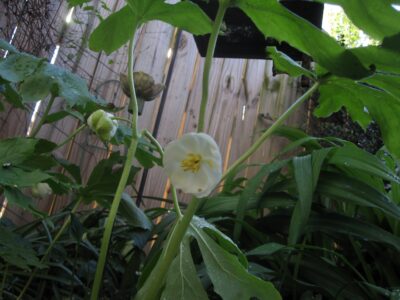
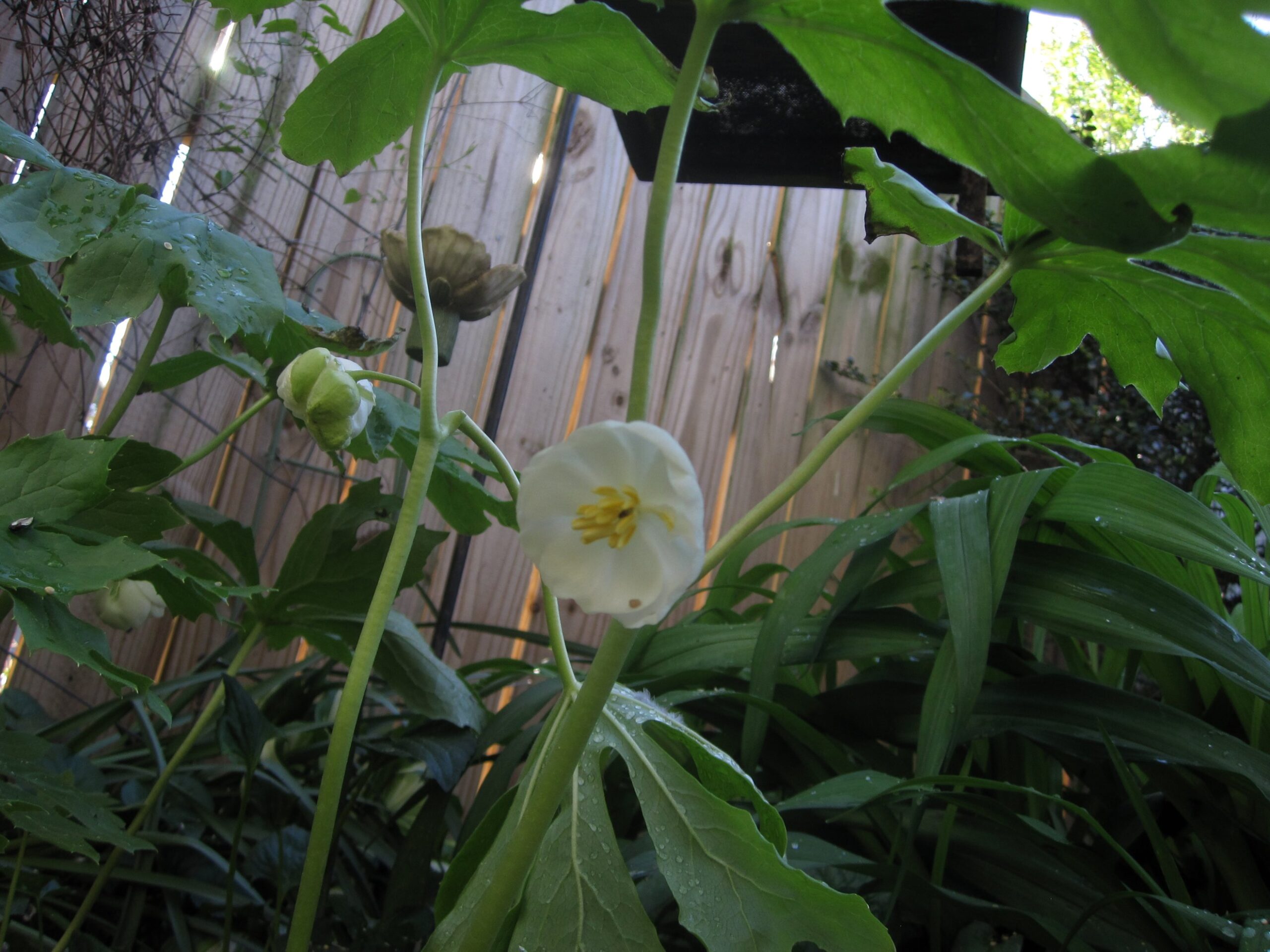
When you see an entire section of forest floor blanketed in what look like tiny green umbrellas, you’re looking at a mayapple colony — and it may be a single organism. Mayapple spreads through underground rhizomes, forming dense mats of genetically identical plants all sharing the same root system.
Only stems bearing two leaves will flower, hiding a solitary white waxy blossom at the fork. The flower develops into a yellow-green berry by summer, beloved by eastern box turtles — seeds that pass through a turtle’s digestive system germinate more readily than those that don’t.
A word of caution: while the ripe fruit is technically edible, all other parts of the mayapple are highly toxic. However, a compound derived from mayapple called podophyllotoxin is the basis for etoposide, a chemotherapy drug used to treat lymphoma and lung cancer since 1983. On our foraging adventures, the mayapple is a perfect example of why expert guidance matters.
Interesting Facts
→ A colony may be one single organism connected by underground rhizomes
→ Only two-leaved stems produce a flower — hidden beneath the umbrella leaves
→ Box turtles are primary seed dispersers — seeds germinate better after passing through them
→ All parts except the ripe fruit are highly toxic to humans
→ Source of podophyllotoxin — used in cancer chemotherapy drugs since 1983
Learn more: Prince William Wildflower Society — Mayapple Profile
Bloodroot
Sanguinaria canadensis
Blooms: Late March – April
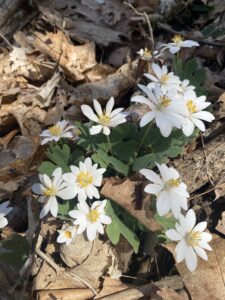
Few spring wildflowers make as dramatic an entrance as bloodroot. Each solitary white flower — with its ring of brilliant golden stamens — rises wrapped inside its own leaf like a gift still in its packaging, unfurling as the bloom opens. But act fast: each bloom lasts only one to three days before the petals drop. Even then, the flowers close at night and on cloudy days — they open only when their pollinators are most active.
The plant’s name tells the rest of the story. Cut the root, and it bleeds bright crimson-red sap — the same sap Native Americans used as a dye for baskets, clothing, and body paint. The genus name Sanguinaria comes from the Latin sanguis, meaning blood. That red sap contains sanguinarine, which has a long and complex medicinal history — it should never be handled carelessly.
Look for bloodroot on the rich, moist slopes and stream banks of Garrett County’s deciduous forests, often in the company of trout lily and spring beauty.
Interesting Facts
→ Each flower lasts only 1–3 days — one of the most fleeting ephemerals
→ Closes at night and on cloudy days when pollinators are inactive
→ Bleeds bright crimson-red sap when the root is cut
→ Native Americans used the sap as dye and body paint
→ Seeds are dispersed by ants (myrmecochory)
→ Member of the poppy family (Papaveraceae)
Learn more: Blue Ridge Discovery Center — Bloodroot
Trillium
Trillium spp. — including Large-flowered, Wake-Robin & Painted Trillium
Blooms: April – May
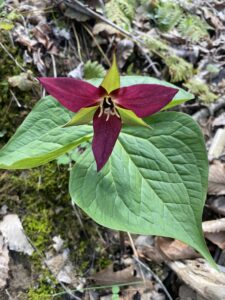
If any spring wildflower deserves the title of queen of the Appalachian forest, it’s trillium. Several species can be found in Garrett County’s woodlands — from the bold, snow-white blooms of large-flowered trillium to the deep burgundy wake-robin and the delicately striped painted trillium. All are unmistakable: three large petals, three broad leaves arranged in a perfect whorl, rising from a single stem in a design so precise it looks almost architectural.
Trillium is not a plant in a hurry. It can take seven years from seed to first bloom — spending most of that time building energy underground. Because of this slow growth, trillium is particularly vulnerable to disruption: picking the flower or leaf deprives the plant of photosynthesis it needs for the following year, and a single careless step can set a plant back years. In some states, picking trillium is illegal.
Like so many spring ephemerals, trillium seeds are also dispersed by ants — the fatty elaiosome attached to each seed is irresistible to them. Undisturbed old-growth forest hollows in Garrett County hold extraordinary concentrations of these plants.
Interesting Facts
→ Perfect triple symmetry — three petals, three sepals, three broad leaves
→ Takes up to 7 years from seed to first bloom
→ Picking the flower or leaf can harm or kill the plant — never pick
→ Seeds dispersed by ants (myrmecochory)
→ Several species in Garrett County: large-flowered, wake-robin, painted trillium
→ Can live for decades once established in the right habitat
Learn more: Appalachian Trail Conservancy — Wildflowers
Pink Lady’s Slipper Orchid
Cypripedium acaule — also called Moccasin Flower
Blooms: May – June
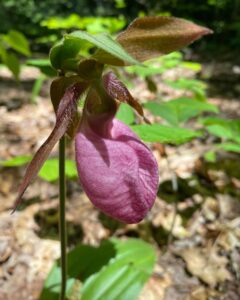
Finding a pink lady’s slipper in bloom is one of the true highlights of a Garrett County spring. This is a native orchid — wild, singular, and unlike anything else on the forest floor. The inflated pink pouch (called a labellum) rises on a single leafless stalk above two broad, parallel-veined basal leaves. The genus name Cypripedium translates as “Venus’s slipper.” Once you’ve seen one, you’ll understand why.
The lady’s slipper is a master of deception. It lures bumblebees inside with its pink color and sweet fragrance — but offers no nectar in return. The bee enters through a slit in the front of the pouch and discovers it has been tricked. Unable to exit the way it came in, it crawls out through a narrow passage past the pollen structures, inadvertently picking up or depositing pollen. Only about 5–10% of flowers are successfully pollinated in any given year.
What makes this orchid even more remarkable is its dependence on a specific soil fungus. The seeds — tiny as dust — cannot germinate without it. This is also why you should never attempt to transplant a lady’s slipper: without its fungal partner, it will almost certainly die. Leave it where it is, and let others find it too.
In Garrett County, look for pink lady’s slippers in acidic forest soils under pines, hemlocks, and mixed hardwoods. Never pick them, dig them up, or disturb the soil around them.
Interesting Facts
→ Native orchid — one of the most spectacular wildflowers in Garrett County
→ Deceives bumblebees with color and scent — offers no nectar in return
→ Only 5–10% of flowers are successfully pollinated each year
→ Seeds require a specific soil fungus (Rhizoctonia) to germinate
→ Cannot be successfully transplanted — never dig from the wild
→ Plants can live 20 years or more
→ Look for them under pines and hemlocks in acidic soils
Learn more: USDA Forest Service — Pink Lady’s Slipper
Jack-in-the-Pulpit
Arisaema triphyllum — also called Indian Turnip
Blooms: April – June
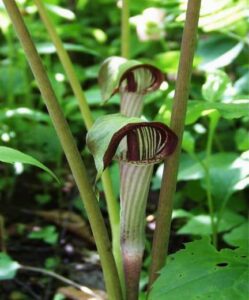
Even among Garrett County’s remarkable cast of spring wildflowers, Jack-in-the-pulpit stands out as the strangest and most theatrical. The hooded green-and-maroon striped spathe — the “pulpit” — curves protectively over a club-shaped spadix called the “Jack,” which is packed with tiny true flowers hidden at its base.
The most extraordinary thing about Jack-in-the-pulpit isn’t how it looks — it’s how it thinks. This plant is one of the few in nature that can change its sex from year to year. Young plants produce only male flowers. As a plant accumulates more energy and resources over successive years, it can spontaneously flip to producing female flowers — and back again in a lean year. The larger and better-nourished the plant, the more likely it is to be female.
Pollination is equally dramatic. Jack-in-the-pulpit attracts fungus gnats with a faint scent. Female plants have no exit hole at the bottom of the spathe, trapping the gnat inside until it picks up pollen and eventually escapes through a gap at the top. Male plants do have an exit, allowing the pollen-dusted gnat to carry pollen to the next female plant.
By late summer, the spathe withers to reveal a spectacular cluster of bright scarlet red berries — eaten by wood thrushes, wild turkeys, and box turtles. All parts contain calcium oxalate crystals and are toxic if eaten raw. Look for Jack-in-the-pulpit in the shadiest, moistest spots in Garrett County’s forests.
Interesting Facts
→ Can change sex from year to year — one of very few plants capable of this
→ Female plants trap pollinating fungus gnats inside with no exit hole
→ Produces vivid bright red berry clusters by late summer
→ All parts are toxic raw — contains calcium oxalate crystals
→ Lives 25+ years; a long-lived perennial of moist deciduous forests
→ Loves shady, wet hollows and stream banks
Learn more: USDA Forest Service — Jack-in-the-Pulpit
Why Spring Ephemerals Matter
Spring ephemerals aren’t just beautiful — they’re integral to the health of Garrett County’s forests. At a time of year when little else is growing, they provide the first nectar and pollen for emerging native bees, flies, and early butterflies like the mourning cloak. Without spring ephemerals, the first pollinators of the season would have almost nothing to eat.
They also perform a quiet but critical service for the forest itself. That narrow window between snowmelt and leaf-out is when forests are most vulnerable to nutrient loss — nitrogen can leach rapidly from bare soils. Spring ephemerals absorb and hold those nutrients in their tissues, then release them slowly back to the soil as they die down, feeding the trees that will soon tower over them. Research has shown that trout lily colonies alone can increase their mass by 250% in just twelve days during peak growth.
These plants are also deeply sensitive to disturbance. Invasive species like garlic mustard outcompete them, deer overpopulation can strip entire forest floors, and careless foot traffic off established trails can destroy colonies that took centuries to establish. This is one reason why joining a guided nature tour matters — our guides know the trails, know the fragile spots, and make sure every visit leaves the forest exactly as we found it.
Tips for Wildflower Watching in Garrett County
→ Go early in the morning — blooms are freshest and the light is perfect for photography
→ Wear waterproof boots — the best wildflower spots are almost always muddy
→ Stay on established trails to protect fragile root systems and soils
→ Never pick wildflowers — many species are legally protected and every plant counts
→ Bring binoculars — some flowers hide under leaves or nod toward the ground
→ Download the iNaturalist app (inaturalist.org) to identify what you find
→ Join a guided tour — local guides know exactly where and when each species peaks
→ Check the Maryland Native Plant Society (mdflora.org) for additional resources
Don’t Miss Your Window
Spring wildflower season in Garrett County is one of nature’s most generous gifts — and one of its most time-sensitive ones. The whole show, from the first skunk cabbage spathe pushing through the ice to the last lady’s slipper fading, spans barely two months. Some individual species bloom for just days.
The good news? You don’t have to know what you’re looking for before you go. That’s exactly what we’re here for.
Explore Garrett County With Us
Guided Hikes & Nature Tours: allearthtours.com/spring-summer-fall-hiking
Foraging Adventures: allearthtours.com/foraging-fun
Phone: (301) 746-4083
Email: Carol@allearthtours.com
Address: 720 Morris Ave, Friendsville, MD 21531